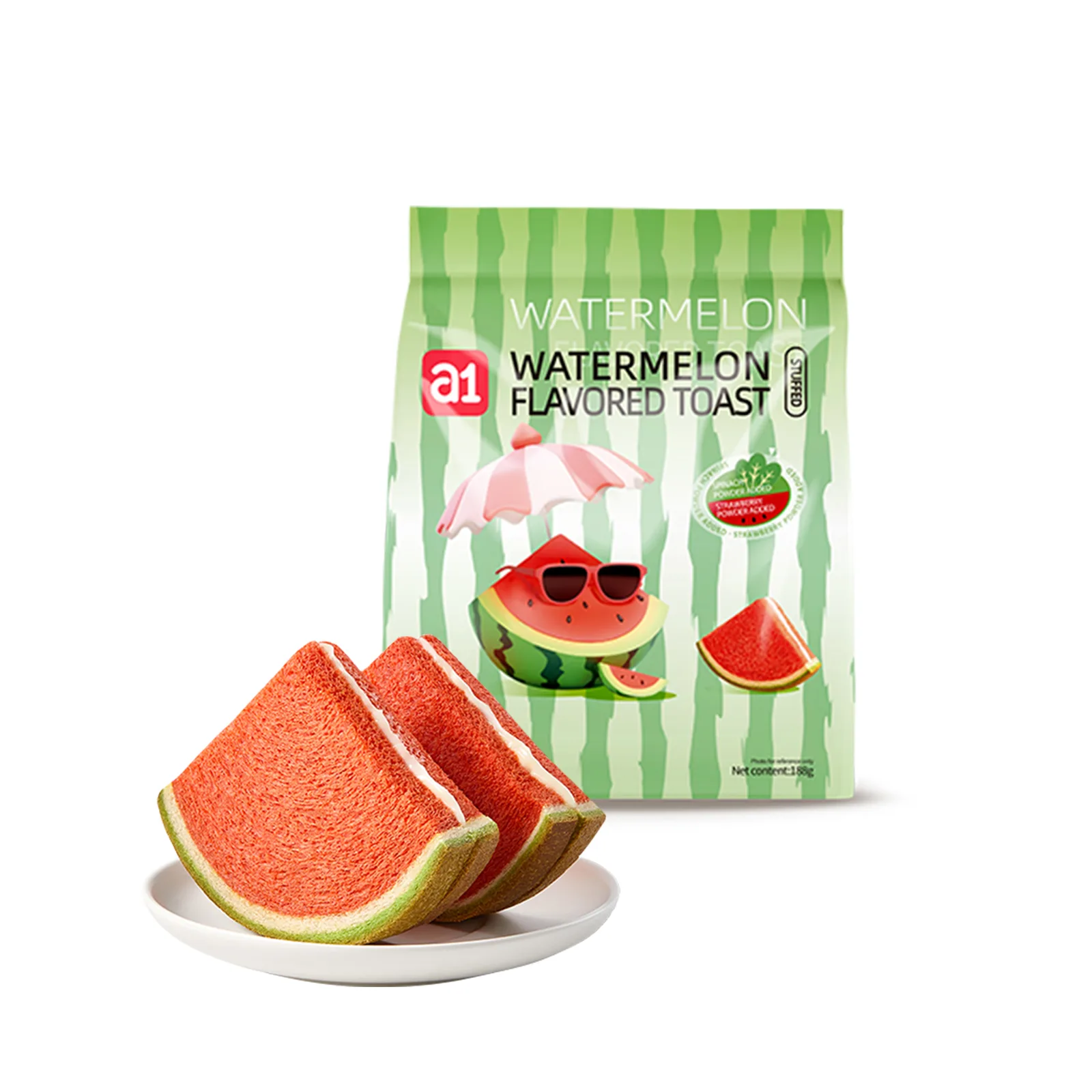
A private-label bakery flavour program usually starts as a sentence — “we want a melon SKU” — and the factory turns that sentence into a recipe, a colour and a pack. Six months later the container lands and the panel says the same thing: not enough melon, too much perfume, the wrong orange. The brief was never a brief; it was a wish.
What follows is the document we would ask a distributor to sign before we open a melon program: the flavour target, where the flavour sits, what the pack may legally say, which colour system carries it, and which lines the trial has to prove.
1. A flavour brief is a spec, not a mood board
“Melon” is not a specification; it is a family of aroma targets. A usable brief fixes seven lines before anyone weighs an ingredient: profile, dosing basis, carrier, bake tolerance, colour source and shade, declaration route, and a retained reference sample. Leave one blank and the factory fills it with its own default — the one that suits its stock, not your shelf.
2. The melon family is three different briefs
One word, three commercial profiles, and buyers describe all three with the same six adjectives.
| Profile | How buyers describe it | What the brief must fix |
|---|---|---|
| Cantaloupe / Hami melon | Perfumed, honeyed, low acid | How much floral is allowed before it reads as perfume |
| Watermelon | Light, watery, red-fruit sweet | Body in the crumb; colour that matches the fruit |
| Honeydew | Green, clean, less sweet | Sweetness ceiling — the green note fades before the sugar does |
Two of the three already run in our bakery range — a stuffed watermelon toast and a stuffed melon-flavoured toast, both on the 188 g four-slice format — with different flavour systems, colour lines and sensory targets. That is why “we want melon” is the first question, not the answer.
3. The flavour lives in the filling, not the dough
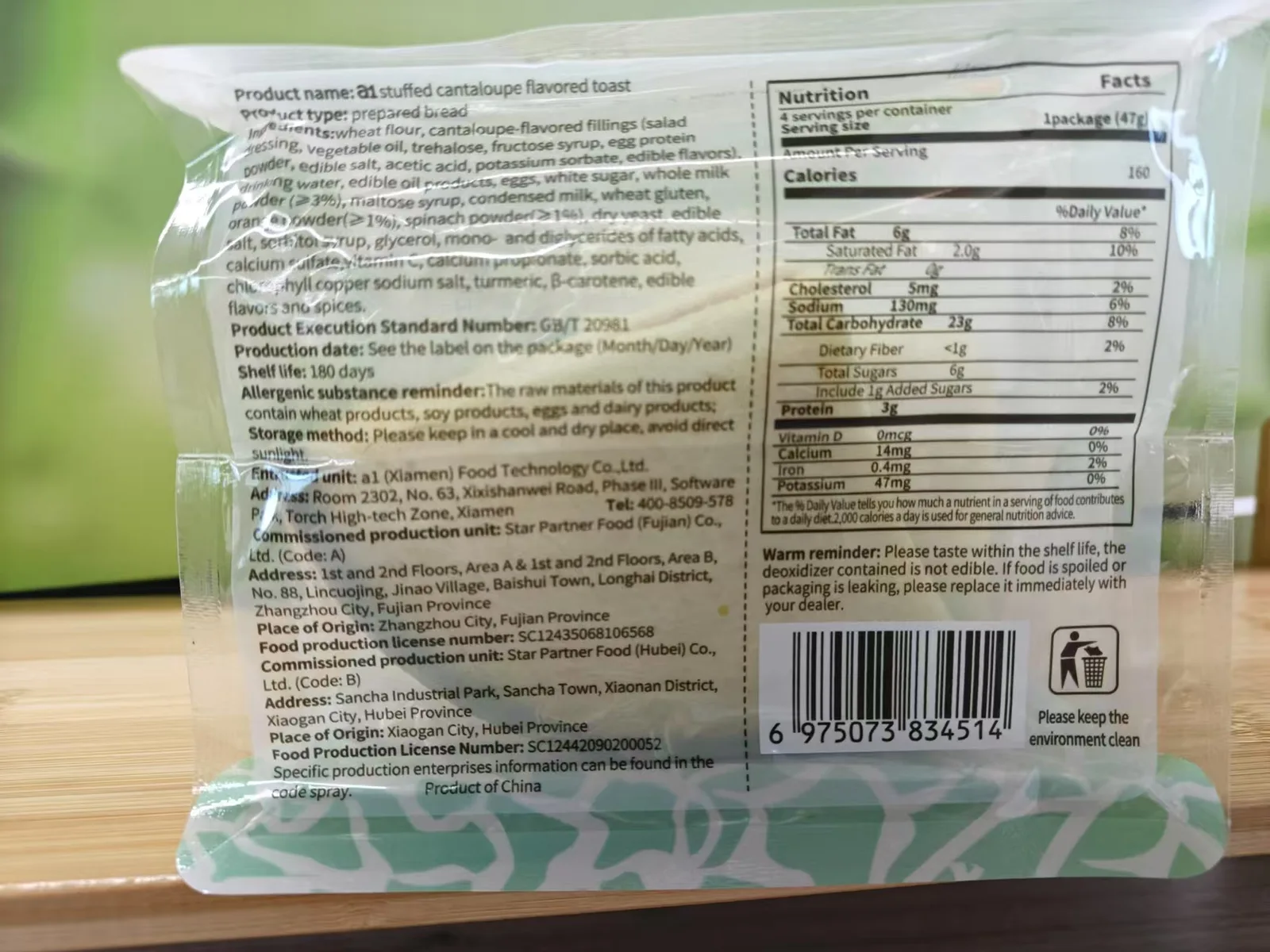
An ambient filled toast is two products in one bag, and only one sees the oven. Volatile top notes are what heat removes first, so flavour dosed into the dough arrives weaker and flatter than the same flavour dosed into the filling. Our cantaloupe pack shows the decision in its ingredient order: the flavoured filling is listed ahead of the flour.
The line that removes most of this risk is the dosing basis — a number against a named phase (grams per kilogram of filling, or of finished product), quoted on the same base by every supplier. Two proposals that both read “0.3%” can differ by a factor of two on the palate.
4. What the pack is allowed to say
Most bakery packs, ours included, declare “edible flavours” as a class, not “cantaloupe extract”, because the flavour is usually a compounded system. The label will not carry your flavour story at retail; the brief has to, and the copy has to stay inside what the declaration supports.
- EU: Regulation (EC) No 1334/2008 governs flavourings; “natural” is tied to the source material and a derivation test (at least 95% of the flavouring component by weight from the named source). As of 2026 that is still the reference buyers check.
- US: declarations sit under 21 CFR 101.22, which sets when a flavour may be called natural and how it is named.
- Both: a front-of-pack fruit claim needs a quantified fruit component; if the brief does not set that percentage, the claim stands on nothing.
Decide early: melon-flavoured and made with melon are different formulas and different paperwork.
5. Colour is a separate decision — and it can break the range
Melon sells on colour before it sells on aroma: a watermelon SKU without red reads as a mistake, a cantaloupe SKU without orange reads as underripe. Colour and flavour are two briefs from two suppliers, and they fail independently.
The colour line also decides which claims stay open. Fruit and vegetable concentrates support a “colour from concentrate” statement; beta-carotene and turmeric are simple and stable; carmine (E120) is insect-derived — legal almost everywhere, but a real constraint the moment a buyer asks for a vegan position or a specific halal ruling.
This is not theoretical here. Our watermelon toast and cantaloupe toast carry different colour lines: the watermelon version lists carmine alongside turmeric and beta-carotene, the cantaloupe version leans on turmeric and beta-carotene. Same family, same format, different declaration. Ask for one artwork across both SKUs and the colour line breaks first — so brief shade (a physical reference, not a screen colour), source and stability separately from flavour.
6. The spec lines that survive an audit
| Spec line | What “done” looks like | Who signs |
|---|---|---|
| Sensory target | Profile, intensity 1–5, and the failure modes named (“perfume”, “flat”, “bitter finish”) | Buyer + QA |
| Dosing basis | A number against a named phase, identical across every quote | Buyer + R&D |
| Bake tolerance | Written confirmation the system survives the process, plus a retained sample | R&D |
| Colour | Physical shade reference, source, and the claim it supports | Buyer + QA |
| Shelf-life checkpoint | Sensory result at the declared end date (180 days on our melon packs), not only at release | QA |
| Declaration route | Agreed wording for the market, plus the allergen list (wheat, soy, egg, milk) | Buyer + regulatory |
7. Freeze the format, move one variable at a time
A program that ends in a decision, rather than another sample, runs three rounds: a bench screen (three profiles, two doses, filling only, unchanged base), a pilot on the real line in the real pack, and a storage round held at the warm end of your market’s range and tasted at the start, middle and end of the declared shelf life.
8. What we changed after running two melon SKUs
When we built the second melon SKU, we kept the format identical — 188 g, four slices, 12 bags to a carton, the same 180-day target — and moved only the flavour and colour system. Most briefs we had seen before that did the opposite: a new flavour and a new pack size in the same round, because the category review and the flavour review sat in one meeting.
That is where results stop being readable. If the panel says “not enough melon”, you cannot tell whether the oven drove off the top notes or the smaller format changed the surface-to-volume ratio and dried the crumb. The expense is an extra sample round and a second set of courier samples, and the answer comes back “not quite”, with no direction attached.
So we switched the order: freeze the format, move the flavour, move colour last — colour has the shortest lead time and is the variable most often blamed for a flavour complaint, because a shade that reads underripe makes tasters call the aroma weak even when the dosing has not moved. Every batch still ships with a COA from our own CNAS-accredited laboratory, and 180 days is the shelf life printed on the pack.
9. Cartons, container maths and the minimum that starts a program
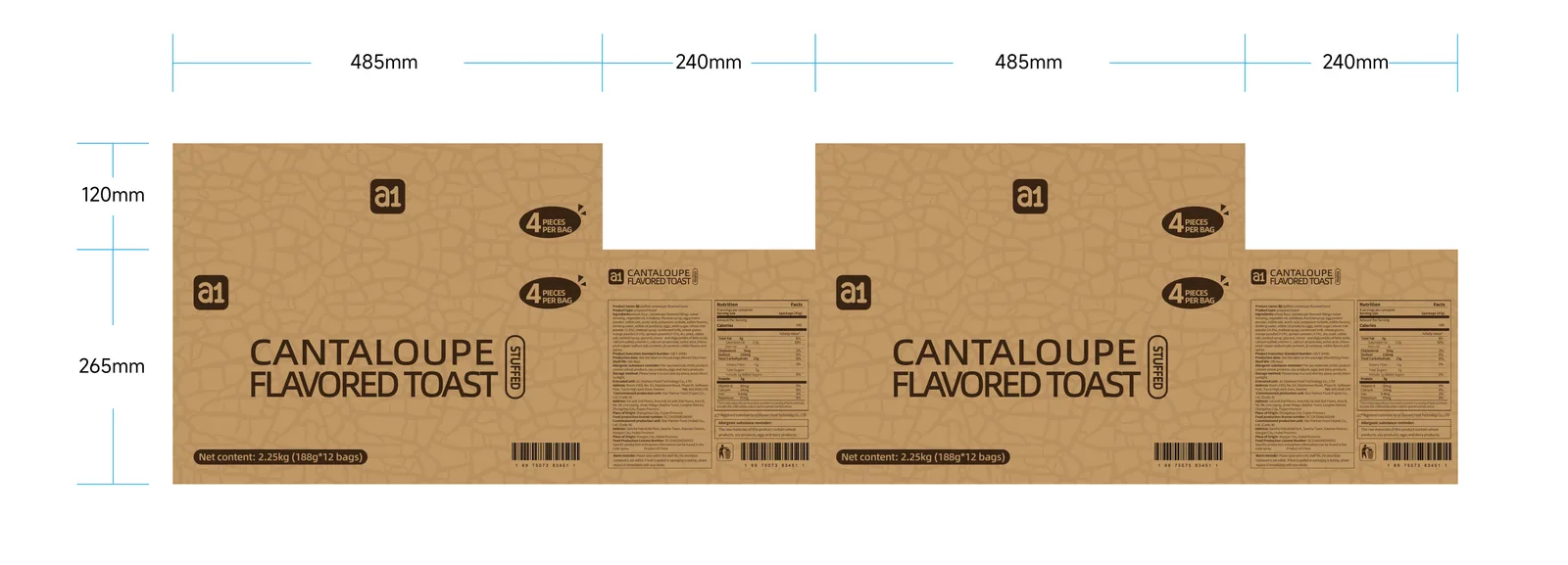
Format sets how many units fit in a container. Our 188 g stuffed melon toast loads 2,204 cartons per 40HQ at 2.25 kg net per carton (12 bags); a 248 g four-slice bread loads 1,860; a 238 g bread 2,000; a 240 g six-piece pudding cake 1,518. None of those numbers move because of flavour — but all of them move the moment the melon SKU should be “a bit bigger”.
MOQ from 500 cartons per SKU, 200-carton trial orders for new markets: enough to run a shelf-life check in one or two stores and still walk away without dead stock.
Frequently Asked Questions
Can a private-label program use melon flavour without real fruit? Yes — the pack then declares “flavouring” as a class, and any fruit claim on the front needs a quantified fruit component the brief must set before artwork approval.
Does the flavour system change the shelf life? It can: carriers and solvents migrate into the crumb and may soften a filling or shift colour, so test at finished-product level across the declared 180 days.
How long does a melon program take? The sequence is fixed — bench screen, pilot, storage check — and the storage round dominates, because it runs the full declared shelf life.
Which certifications come with the batch? FSSC 22000, BRC, HACCP, HALAL and BSCI on the site side; a COA from our CNAS-accredited laboratory for every batch. For the United States we operate as an FDA-registered food facility — registration, not an approval of any product.
What is the minimum order? MOQ from 500 cartons per SKU, 200-carton trial orders for new markets.
If you are writing a melon brief now, send the target market, the shelf you are aiming at and the format you have in mind; we will come back with profile options, colour lines that support your claim, and the spec sheet in the form we would sign it. Write to Katherine or Justin@a1food.cn, or WhatsApp +86-189-6548-2111. The bakery range and the stuffed melon-flavoured toast show where these briefs end up; the watermelon toast shows a different colour line on the same shelf. For the mechanics behind the 180 days, read why six-month shelf life wins supermarket bids; samples start on the contact page.