
Gummy supplement claims rarely sink a launch at the recipe stage. They sink it at artwork sign-off: a line that is routine in one market becomes a labelling problem in the next. "Supports immune health" is a structure/function statement on a US supplement pack; on an EU food supplement pack it may not be authorised wording at all. This page answers what a distributor asks before a print file is released — what counts as a claim, who owns it, how the US, EU and GCC rules differ, and what evidence sits behind a printed line. We make functional gummies and ship to 40+ markets, so this is written from the buyer's side of the artwork table.
Four types of lines get called claims
Buyers say "claim" for four different things, and each follows a different path. Mixing them is how a harmless sentence turns into a problem.
| Line type | What it does | First check |
|---|---|---|
| Statement of identity | Declares food, food supplement or dietary supplement. | Classification sets the whole label path. |
| Nutrient content claim | States a level, e.g. "high in vitamin C". | Defined thresholds; wording is not free. |
| Structure/function claim | Describes a role in normal body function. | Needs substantiation; in the US, a disclaimer. |
| Disease claim | Says the product treats or prevents a condition. | Medicine territory; not for a food gummy. |
None of these lines becomes true because a supplier printed it. Classification, market and evidence file have to line up first — which is why the brief, not the artwork, is where compliance starts.
Who actually owns the words on the pack
In a contract program the factory builds to a specification; the brand owner decides what the pack says. In the United States the FTC substantiation standard falls on whoever places a claim in labelling or advertising — normally the marketer. The contract manufacturer does not answer for wording it did not write (KOR Nutra, as of 2026). A supplier offering to "handle the claims" is offering you a responsibility that still sits with your brand.
Ask for a claim sheet before a print file: exact wording, destination market, evidence file and the person signing it. If any field is blank, the artwork is not ready. Our market-by-market background sits in the functional gummy claims guide.
United States: structure/function and the 30-day rule
Under the Dietary Supplement Health and Education Act of 1994 (DSHEA), a gummy positioned as a dietary supplement is regulated as food, not a drug. Structure/function statements such as supporting immune health are permitted when truthful, not misleading and substantiated. They must carry the required disclaimer in prominent type: this statement has not been evaluated by the Food and Drug Administration, and the product is not intended to diagnose, treat, cure or prevent any disease. The claim must be notified to the FDA within 30 days of first marketing it (KOR Nutra, as of 2026).
Disease claims are off the table: a line about treating insomnia turns a supplement into a drug claim. "High in vitamin C" carries a defined threshold — 20% or more of the Daily Value per serving (as of 2026) — and authorised health claims need significant scientific agreement and pre-clearance. The panel is fixed too: statement of identity, net quantity, Supplement Facts, descending ingredient list, and the manufacturer or distributor address. For the United States, a1 is an FDA-registered food facility; registration is not an approval of any product.
European Union: authorised wording, not creative wording
Food supplements fall under Directive 2002/46/EC; health claims are governed by Regulation (EC) 1924/2006 and must appear on the EU authorised list (Zoomsheal / GTT Bio, as of 2026). Member states keep their own vitamin and mineral lists, so a formulation that fits one country may need adjusting for another. Candy-style gummies draw extra scrutiny: a confection-looking pack is a label question before a recipe question.
Do not invent a wording. Confirm the authorised phrase, conditions of use and target member state before artwork is locked. The UK has kept a separate register since 2021. Final on-pack claims follow the regulations of each target market; a1 does not issue compliance opinions.
GCC routes: HALAL, Arabic pack and registration windows
Gulf markets add a layer unrelated to the recipe: an Arabic pack, national registration, and import files checked against the certificate set. Verify that the HALAL certificate names the actual production site, not a trading company (Zoomsheal, as of 2026). An intermediary certificate will not clear a shipment when an authority asks where the goods were made.
Registration is a timeline item — industry guidance puts the cycle at three to nine months depending on the authority (as of 2026). Plan the launch calendar backwards; a clearance in one Gulf state is information about that state only.

A three-market claim map for the brief
One sentence cannot be judged in the abstract. Put the market beside it and most arguments end before the print stage.
| Proposed line | United States | European Union | GCC |
|---|---|---|---|
| "Supports immune health" | Substantiation, disclaimer, 30-day notification. | Only if an authorised wording exists. | Check national register and Arabic text. |
| "High in vitamin C" | 20% DV per serving (as of 2026). | Regulated wording; check member state list. | Confirm local nutrient rules and language. |
| "Helps you sleep" | Watch for implied disease claim. | Authorised wording only. | High-scrutiny line; verify locally. |
| "Suitable for vegans" | Check the full formula, including the base. | Pectin and gelatine are not interchangeable. | Align certificates with the pack claim. |
A decision frame, not a permission slip: the destination authority's current rules win, and final on-pack claims follow the regulations of each target market.
The paper behind every printed number
Our confectionery line holds a 12-month ambient shelf life, and stability runs on the finished product in the actual pack — not the premix. Freeze film, seal and format first; change them later and the data no longer describes what ships. Every batch leaves with a COA from our CNAS-accredited laboratory and full traceability, so a printed number traces back to a measured lot. Dose and overage are covered in the vitamin gummy development guide.
Ask for the protocol, release values, one interim point and end-of-shelf-life values against the claim. A certificate on the wall is not a batch file.
Why we stopped using one claim block for all SKUs
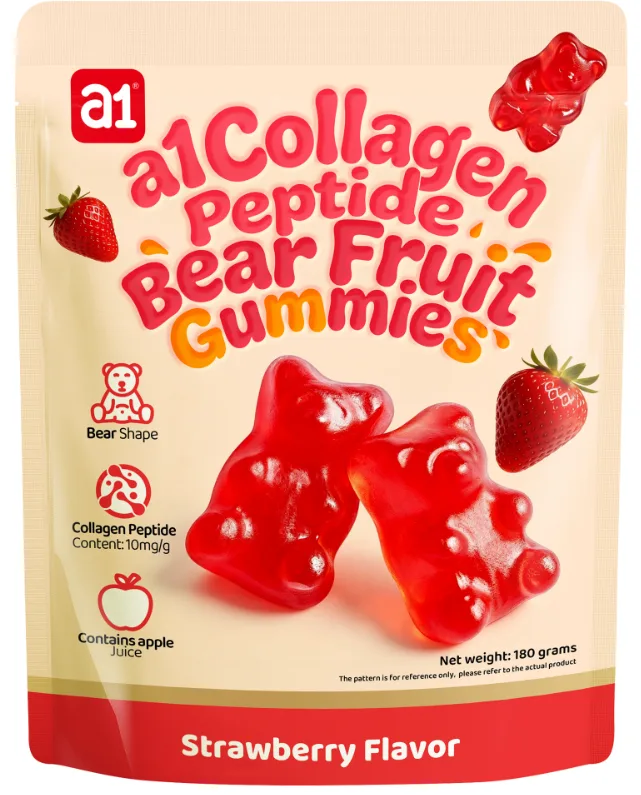
We ran a pack review across our functional range before building a multi-market artwork set: six SKUs — collagen, GABA, vitamin C, lutein with DHA, zinc and calcium — plus a collagen bear pack printing "Collagen Peptide Content: 10 mg/g" and "Net weight: 180 grams" (2026 range). We found the basis was not uniform: vitamin C per 25 g serving, zinc per 100 g, collagen per gram. A shared claim block would have carried three incomparable numbers, and a sentence cleared in one language set would have travelled where it is not authorised.
The downside lands after the container has moved: a pack relabelled, or a statement withdrawn at the shelf. We rejected the shared claim block and switched to a per-SKU claim sheet — one page per SKU and destination with the active basis, exact wording, evidence file and COA reference. That is the file we will put behind an artwork signature.

The artwork release checklist
- Classification per destination — food or supplement.
- Claim inventory word-for-word — line, type, market.
- Substantiation — assay, stability, COA reference.
- Disclaimer and language check — local rules.
- Pack frozen — film, seal and format match the study.
- Sign-off recorded — names, date and version on the claim sheet.
- First-order lane — trial route fixed before the container.
If a supplier cannot complete these seven items with you, the artwork is a draft. Treat it as one.
MOQ and how to start
Start with the market and wording, then the format. A functional program does not need a full container to test the label: MOQ from 500 cartons per SKU, 200-carton trial orders for new markets. Our private label gummy vitamins page sets out the path; samples start on the contact page.
Frequently Asked Questions
Can one pack carry the same claim in the US, EU and GCC? Rarely. Classify for each destination, then check permitted wording. A line that works in one market may need a disclaimer, an authorised phrase or removal.
Who owns a private-label claim? The brand owner or marketer carries the substantiation burden. The contract manufacturer builds to specification and does not clear the brand's claims (KOR Nutra, as of 2026).
Structure/function versus disease claim? The first describes normal body function and, in the US, needs substantiation and the disclaimer. The second says the product treats or prevents a condition — medicine, not a food gummy.
What evidence comes with the pack? Stability on the finished product in its final pack, assay results against the declared value, and a COA from a CNAS-accredited laboratory with full traceability. We hold FSSC 22000, BRC, HACCP, HALAL and BSCI. For the United States, a1 is an FDA-registered food facility — registration, not approval.
What is the minimum order? MOQ from 500 cartons per SKU, 200-carton trial orders for new markets.
Send us the destination market, the exact lines you want on pack and the serving basis. We will return what our data supports and what needs local review — final on-pack claims follow the regulations of each target market. Write to Katherine or Justin@a1food.cn, or WhatsApp +86-189-6548-2111.