
Private label gummy artwork is where most first runs go wrong — not in the recipe or on the depositing line. The formula is usually settled; the pouch is not. A layout that looks right on screen can reach the printer with a window over the seal, a net-weight field that no longer matches the pack, or a barcode that will not scan at retail. We make gummies and ship to more than 40 markets, and this page is the sequence we use to keep a print file from becoming a reprint. It answers what a brand owner asks before sign-off: what a dieline fixes, which fields change SKU by SKU, how first runs fail, and what to demand at each proof stage.
Artwork is not a dieline — and the mix-up is the first failure
These are two different deliverables, and buyers routinely commission the first while assuming they have the second. The dieline is the flat, dimensioned outline of the pack: where the panel folds, where the seal band sits, where the hang hole and tear notch go, and how far from each edge artwork may print. The artwork is the visual content inside that outline — brand, flavour, fruit image, icons, declarations. A beautiful artwork file dropped onto a never-frozen dieline is the classic first-run failure.
| Deliverable | What it controls | If it is missing |
|---|---|---|
| Dieline | Pack geometry, seal band, safe area, window and notch positions. | Artwork drifts into areas the machine cannot print or seal. |
| Artwork | Brand, flavour, imagery, icons, declarations, barcode. | No pack to print — a design file is not a production file. |
| Version record | Which field changed, who approved it, which SKU and market. | Nobody can reproduce or trace the file that was actually printed. |
Ask for the dieline before the artwork brief. A private label manufacturer normally keeps dieline templates for its standard pouches — ours run from 40 to 200 g and can be set to a buyer's required weight.
The fields that must change SKU by SKU
A shared artwork master looks efficient until one field is left unchanged across a range. Check these per SKU:
- Identity and flavour — the exact name read on shelf.
- Net weight — the declared figure must match the format filled.
- Ingredients and allergens — ordered and worded for the destination.
- On-pack statements — wording tied to a formula or market.
- Barcode and traceability codes — unique, scannable, in the quiet zone.
- Batch and date-code position — a reserved area, not filled later.
A screen proof is least useful for the last two: a code that looks fine in a PDF can fail on a curved seal or dark gradient. Lock their positions on the dieline, not the design file.
Where first runs actually go wrong
Most failures are mechanical. The same five recur:
| Failure | Root cause | Where to catch it |
|---|---|---|
| Window or text over the seal | Safe area not fixed on the dieline. | Dieline review, before design. |
| Net weight does not match pack | Field copied between formats. | Per-SKU field check. |
| Barcode will not scan | Quiet zone violated or print too dark. | Physical proof scan test. |
| Colour drifts from the approved proof | No agreed reference under defined light. | Signed physical proof as the standard. |
| Artwork version ambiguity | Several files in circulation, no version tag. | One signed file, one version number. |
Every one is cheaper to fix before the film is made than after printing.
Proof stages: screen, physical pouch, pilot run
Three checks are often treated as one, but they prove different things — skipping a stage is how a problem survives to the container.
Screen proof. Checks spelling, layout and field completeness — but not colour on film, seal integrity, or whether a code scans on a filled pouch.
Physical pouch proof. Printed on the intended film. Holds the colour reference under agreed light, lets you scan the barcode, and shows whether text survives the seal band and window edge.
Pilot run. The artwork on the production line, with real product — the only stage that shows whether the pack fills, seals and travels as intended. The stability file must already match the pack; changing the pouch after testing invalidates the data.
Ask which of the three your supplier has completed, and request the physical proof, not a screenshot, before sign-off.
Who owns the file and signs the revision
In a contract programme the brand owns its artwork and the marketer owns the claims; the factory builds to the file it is given and keeps the pack dieline for its standard formats. Confusion over which file is authoritative causes more reprints than printing errors do. Put one line in the brief: who approves a revision, and in what form. A signed version record should name the SKU, the market, the field changed and the date — not a file called "final_v3".
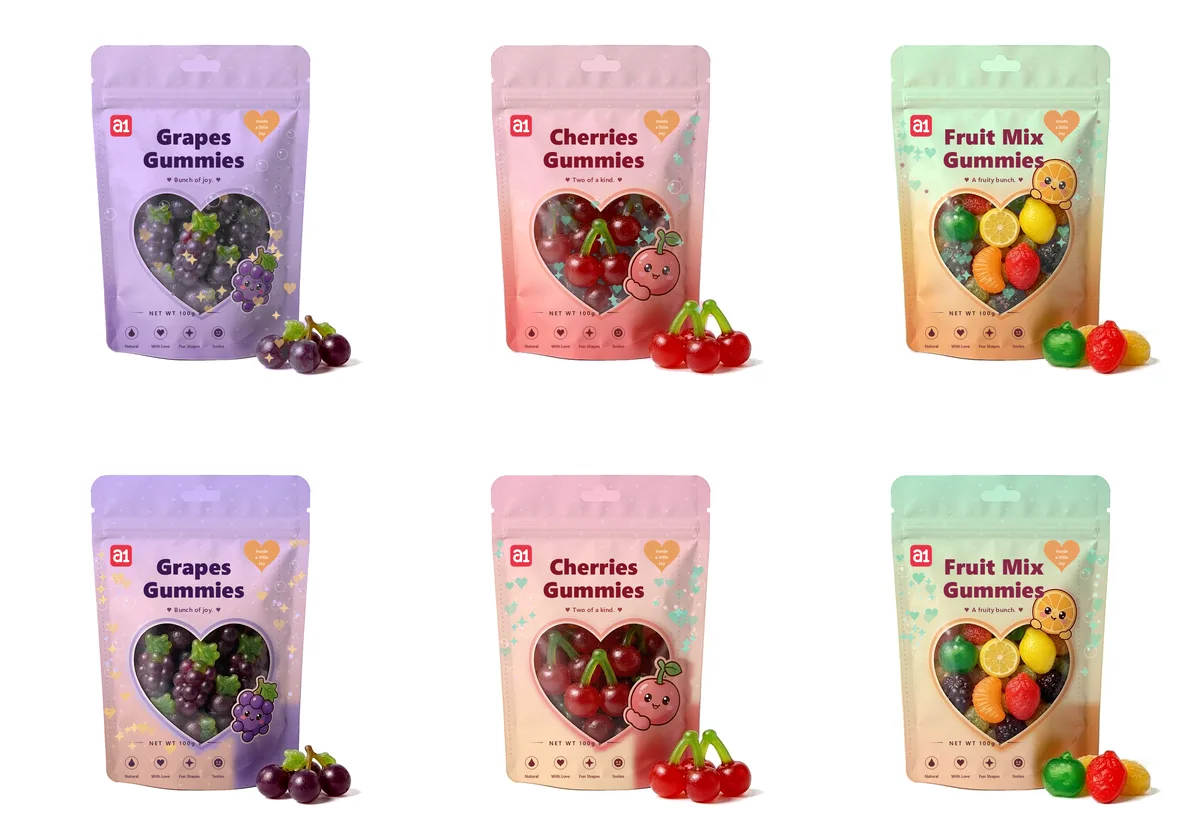
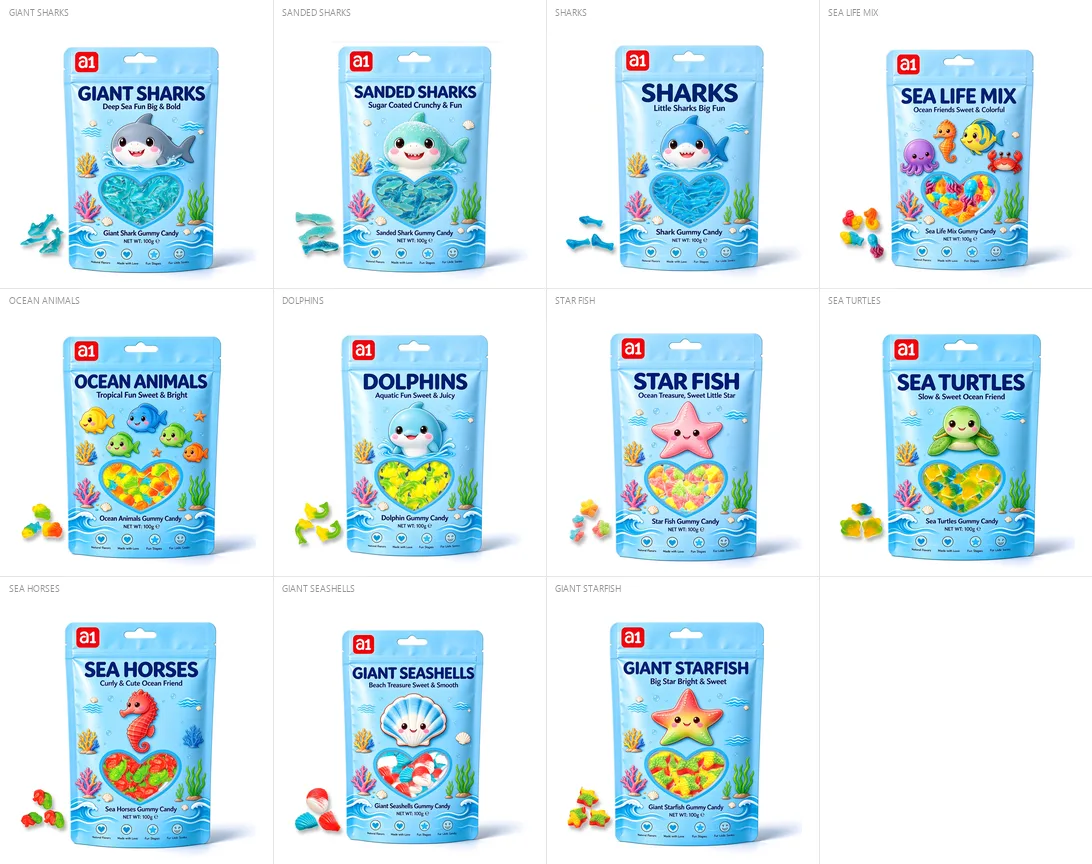
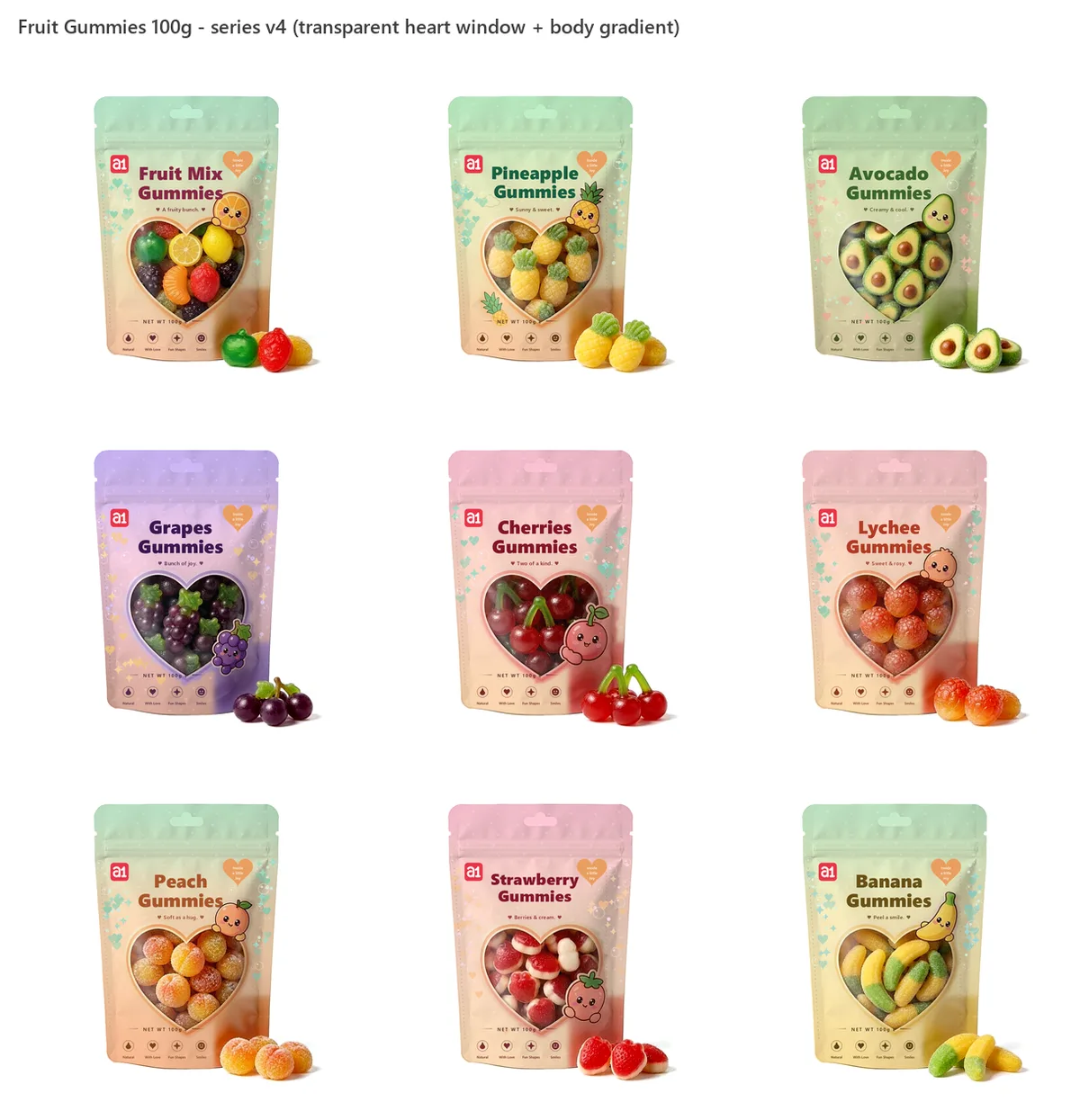
Our range shows why this matters. We ran a pack review across a fruit series of nine SKUs sharing one heart-window layout, and an ocean series of eleven SKUs on a common pouch structure. Consistent geometry made the range readable on shelf — but only because each SKU's fields were tracked against the same frozen dieline, not edited freehand. If you are choosing between a stock formula under your brand and a custom one, the trade-offs are in the custom gummy manufacturer vs private label guide; the artwork path differs between the two.
Freeze the pack before you freeze the art
Packaging is not a finishing step. The film, seal and format decide how a gummy behaves on a long route, and the confectionery line carries a 12-month ambient shelf life (as of 2026). Moisture migration, colour fade and active degradation are all influenced by the pack — which is why dieline and artwork decisions belong with the stability plan. Change the film after the study and the data no longer describes what ships.
For hot, humid destinations, ask what barrier the chosen structure provides and whether the printed window affects it. A window is a design choice with a pack consequence. Our stand-up pouches run from 40 to 200 g; weight is set per buyer, so confirm the dieline against the final format, not an assumed one.
Claims and allergens follow the destination market
Artwork is where a formula becomes a public statement. Ingredient order, allergen wording and any on-pack line must be checked against the rules of the market where the pouches will be sold, not where they were designed. Functional concepts such as collagen, vitamin C, lutein with DHA, zinc or calcium are positioning concepts only; final on-pack claims follow the regulations of each target market, and a1 does not issue compliance opinions. For the United States, a1 is an FDA-registered food facility — registration is not an approval of any product.
Give your supplier the exact wording, destination and evidence file behind each line before release. Our gummy supplement claims guide by market shows how the same sentence is treated in the US, EU and GCC. Allergens are non-negotiable: wording acceptable in one country may need changing in the next.
The artwork release checklist
- Dieline frozen — geometry, seal band, window, notch and safe area fixed.
- Fields checked per SKU — identity, net weight, ingredients, allergens, statements.
- Barcode verified — unique, scannable on a physical proof.
- Physical proof signed — colour reference agreed under defined light.
- Claims reviewed — wording, destination and evidence recorded.
- Pack matches stability — film, seal and format unchanged since the study.
- Version recorded — SKU, market, changed field, approver and date.
If a supplier cannot complete these seven items, the artwork is still a draft. Treat it as one.
MOQ and how to start
Start with the pack, then the art: confirm the format and dieline, freeze the per-SKU fields, then release the print file. A private label programme does not need a full container to prove the artwork — MOQ from 500 cartons per SKU, 200-carton trial orders for new markets. Our private label gummy vitamins page sets out the path, and samples start on the contact page.
Frequently Asked Questions
Dieline versus artwork? The dieline is the dimensioned flat outline — folds, seal band, window, notch and safe area. Artwork is the visual content inside it. One is a production file, the other a design file.
Can one artwork master serve every SKU? Only the layout. Net weight, ingredients, allergens, on-pack wording, barcode and code position must be checked per SKU and per destination market.
Why did our first print run fail though the PDF looked right? Most failures are mechanical: a window over the seal, a net-weight field copied between formats, a barcode that will not scan on a curved pouch, or an unclear version. A screen proof cannot catch these.
Who owns the artwork and dieline? The brand owns its artwork and claims; the factory maintains the pack dieline for standard formats. Put the approval path and version ownership in the brief in writing.
What documents come with a gummy pack? A COA from our CNAS-accredited in-house laboratory with full batch traceability, plus the stability file on the finished pack. We hold FSSC 22000, BRC, HACCP, HALAL and BSCI. For the United States, a1 is an FDA-registered food facility — registration, not approval.
What is the minimum order? MOQ from 500 cartons per SKU, 200-carton trial orders for new markets.
Send us the pouch format, SKU list and destination markets. We will return the dieline and field checklist — final on-pack claims follow the regulations of each target market. Write to Katherine or Justin@a1food.cn, or WhatsApp +86-189-6548-2111.