
A distributor ordering a sugar-free gummy line usually asks one question first, and it is not about the sweetener: “If I list this, exactly what can I print on the pack?” That line decides which shelf the SKU sits on, whether an importer must reprint artwork at his own cost, and whether the container clears customs without a hold. Sugar-free is not a flavour decision — it is a labelling decision that happens to taste sweet.
This guide covers what importers, wholesalers and chain buyers in the US and EU ask us most often: how the two markets define “sugar-free” differently, what each sweetener system does to taste and texture, and the checks to run before a PO is signed.
1. Two markets, two different legal definitions
The most expensive misunderstanding in sugar-free confectionery is that “sugar-free” is one global standard. It is not: the US defines the claim per serving, the EU per 100 g. A recipe that clears one market can fail the other on the same line of text.
| Label claim | United States | European Union |
|---|---|---|
| Sugar-free | Less than 0.5 g of sugars per serving (21 CFR 101.60(c)) | No more than 0.5 g of sugars per 100 g or 100 ml (Reg. (EC) No 1924/2006, Annex) |
| Reduced / no added sugar | Reduced: at least 25% less sugar per serving. No added sugar: no sugars added, with defined exceptions for certain ingredients | Reduced: at least 30% less sugars. No added sugar: no added mono- or disaccharides, and naturally occurring sugars must be declared |
| Polyols | Declared as “sugar alcohol”; most polyols calculated at 2.4 kcal/g, with 0.2 kcal/g permitted for erythritol under FDA’s 2019 guidance | Counted as carbohydrate; more than 10% added polyols requires the statement “excessive consumption may produce laxative effects” |
The trap is arithmetic. A 25 g serving with 0.4 g of sugar is sugar-free in the US; per 100 g that is 1.6 g of sugars, over three times the EU threshold, so in the EU the claim is unavailable at any serving size. Fix the reference basis before you fix the formula — and have artwork reviewed against the current text by a local regulatory advisor, since rules change and category limits exist.
2. The sweetener toolbox and its effect on the product
- Polyols — maltitol syrup, sorbitol, erythritol, isomalt, xylitol. They replace sugar’s bulk, which most buyers underestimate: body without sugar, but with a cooling mouthfeel and a laxative threshold to manage on pack. Erythritol is the least calorific; maltitol syrup gives the closest texture to sugar and is the workhorse of gummy formulations.
- Steviol glycosides (E960 in the EU). High-intensity, no bulk; authorised in the EU with per-category maximum levels and GRAS in the US.
- Sucralose (E955), acesulfame K (E950), aspartame (E951). Also bulk-free, so they are paired with a polyol or fibre bulking agent. Aspartame adds an EU requirement: “contains a source of phenylalanine”.
- Monk fruit and allulose. Attractive in the US, where allulose is excluded from total and added sugars under FDA’s 2019 guidance — but not interchangeable with the EU authorised list. Confirm authorisation status in each market before locking a recipe.
3. Texture is where most sugar-free programmes fail
Sugar does four jobs in a gummy besides tasting sweet: it provides bulk, holds moisture, controls crystallisation and sets the water activity that determines shelf life. Remove it carelessly and the symptoms appear two months later in a hot market — gummies that sweat in the bag, stick together or collapse in a 40°C container. So we treat sweetener and gelling system as one decision. Our line runs four architectures across 19 SKUs:
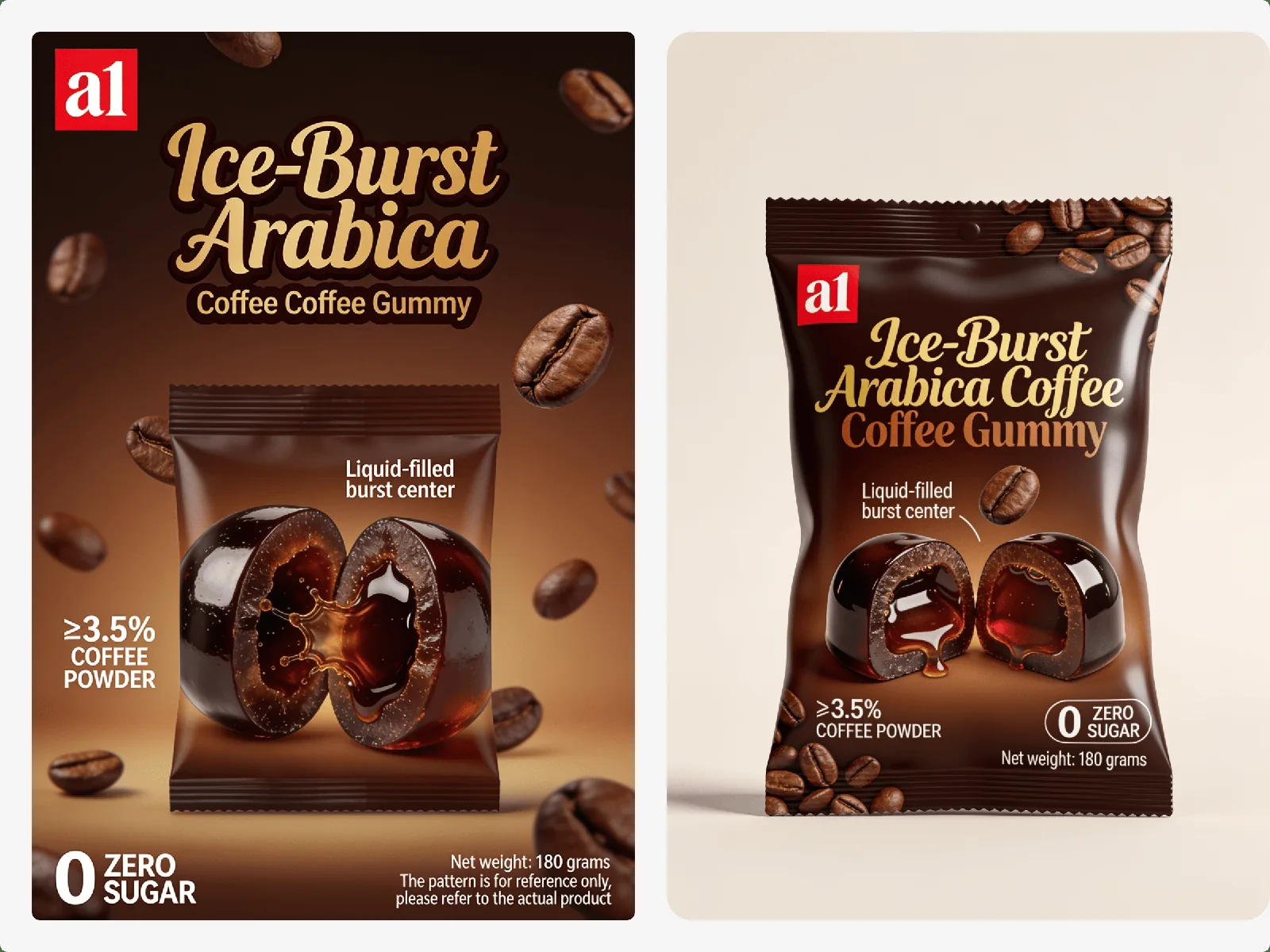
- Polyol systems for the zero-sugar line. The Ice-Burst Arabica Coffee Gummy is zero sugar, on a maltitol, erythritol and sorbitol blend with a liquid burst core — a format where the polyol cooling note works with the flavour.
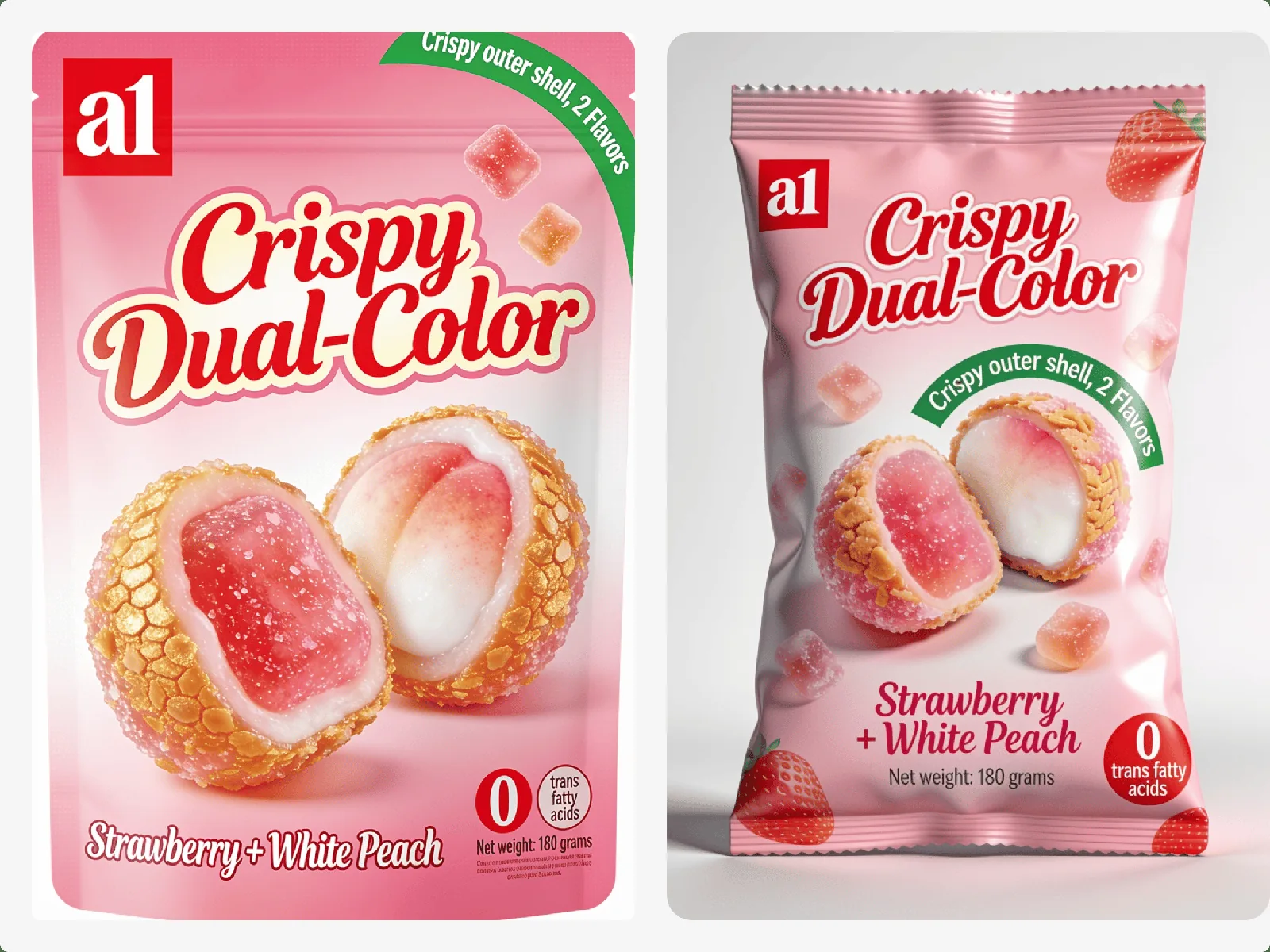
- Gelatine-free agar and pectin systems. Used across the 4D Crispy Dual-Color Gummies for a crisp shell over a soft centre without gelatine, keeping it open to vegetarian and halal-sensitive listings.
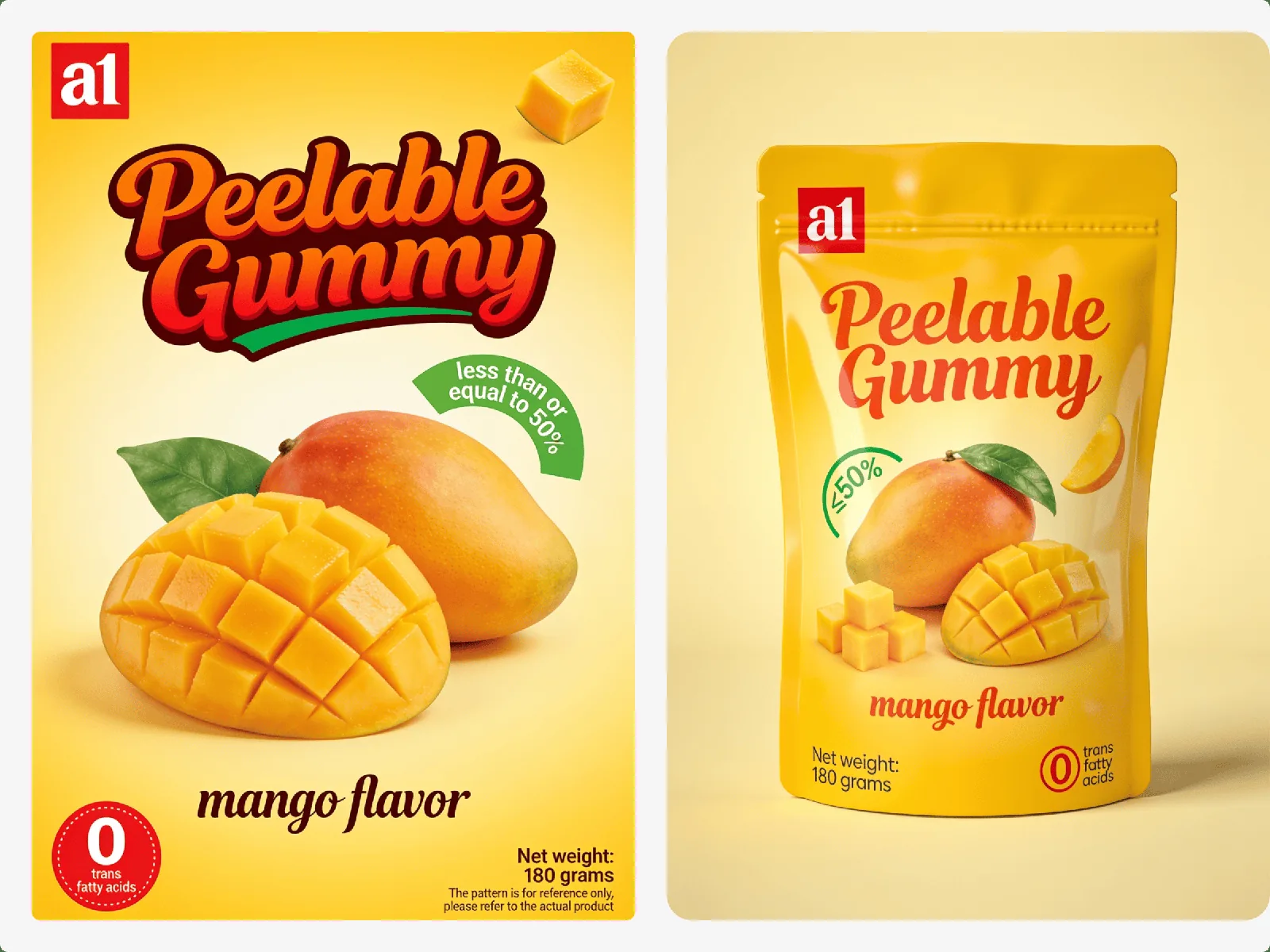
- High-juice pectin systems. The peelable line carries 50% real fruit juice with zero trans fat, so fruit solids do part of sugar’s old bulking work.
- Fruit-prep filled systems. Sour sanded gummies with a real fruit jam centre at 2.0% or more and natural colours, so sweetness rides on the filling, not the shell.
The line runs a 12-month ambient shelf life in stand-up pouches of 40–200 g, weighted to your specification. If your market is tropical, heat stability matters as much as the sweetness profile — that trade-off is covered in our guide to pectin versus gelatine gummies.
4. Functional sugar-free: the claim is the hard part
Six SKUs in our range sit in the better-for-you space — collagen, GABA, vitamin C, lutein with DHA, zinc and calcium. Health and nutrition claims are regulated separately from composition, and permitted wording differs between the US, the EU and the Gulf. Our rule is blunt: the ingredient is a positioning concept, and the final on-pack claims follow the regulations of each target market. We supply the concept, the formula and the substantiation; wording is agreed with your regulatory reviewer before artwork is released. Distributors who treat claims as design rather than law tend to reprint their first two production runs — the same discipline applies to our guide on building a better-for-you gummy line from collagen to DHA.
5. A label review checklist to run before you sign the PO
- Fix the reference basis — per serving (US) or per 100 g (EU). It drives the formula.
- Choose the claim before the recipe — each claim carries different limits and different marketing value.
- Verify the sweetener is authorised in that market and category — US legality does not imply EU legality.
- Check the polyol load against the laxative trigger — more than 10% added polyols in the EU; per-serving thresholds in the US.
- Confirm the nutrition panel treatment — sugar alcohol declaration and calorie basis per polyol.
- Pressure-test texture in transit conditions — ask for travelled samples, not samples straight off the line.
- Get artwork signed off locally before the order — a printed film with a wrong claim means a reprint and a delay.
Two commercial notes belong here. We work to MOQ from 500 cartons per SKU, with 200-carton trial orders for new markets — the trial window lets a claim and a texture be validated in a real market before a full programme is committed. And since sugar-free sells on format as much as on claim, ask about the mixed loading options that let one 20GP or 40HQ carry a range, not a single SKU.
6. What sits behind the pack: factory, lab and certificates
A label claim is only as good as the factory that can repeat it batch after batch. Our lines run across two production bases and eight production lines, supported by three R&D centres and more than 200 patents, with an in-house CNAS-accredited laboratory. Every shipment is released with a certificate of analysis and every batch is traceable from raw material intake to pallet. The sites hold FSSC 22000, BRC, HACCP, HALAL and BSCI certification and operate as FDA-registered food facilities. These lines supply systems including Sam’s Club, Costco, 7-Eleven, Kaufland, Lawson, GS25, Circle K, SM Group, Magnit, X5 Group, Samokat and FamilyMart, across more than 40 export markets.

The format anchoring the zero-sugar line is worth reading in full: why distributors source Arabica chews for on-the-go channels — the clearest example of how a sugar-free formula, a liquid core and a piece of packaging design can hold a shelf position a plain sugar-free bag cannot.
7. Next step
Send us three things and we will come back with the sweetener system that fits, its texture and shelf-life implications, and a sample plan: your target market, the claim you want on pack, and your sales channel.
- Contact: Katherine, export team — en.a1food.cn/contact.html
- Email: Justin@a1food.cn
- WhatsApp: +86-189-6548-2111
- MOQ: from 500 cartons per SKU, with 200-carton trial orders for new markets
Sugar-free is not a shortcut around labelling — it is the category where labelling is the product.