
When a supermarket chain, a club store or a convenience franchise lists an imported bakery SKU, the decision is rarely made on taste alone. Before the first purchase order, the buyer’s QA department builds an audit file on the factory behind the product — and if the certificates in that file do not line up, the SKU never leaves the meeting room. This guide is the checklist our export team walks through with chain buyers: what BRC, HACCP, Halal and the surrounding documents actually prove, how they are verified, and what our own bakery line holds.
1. The certification stack chain buyers ask for
Not every certificate carries the same weight. What most European and Asian chains require first is a GFSI-benchmarked food safety certificate — BRCGS and FSSC 22000 sit at the top of that list. Underneath both sits HACCP, the hazard-analysis methodology those schemes are built on. Alongside them, market-entry certificates such as halal for the Gulf and much of Southeast Asia, and social-compliance audits such as BSCI for European retail groups, complete the pack.
| Certificate | What it proves | Who typically asks |
|---|---|---|
| BRCGS | GFSI-benchmarked site audit covering food safety and quality management | UK and EU chains, club stores |
| FSSC 22000 | GFSI-benchmarked scheme built on ISO 22000 | Global retailers and food manufacturers |
| HACCP | Documented hazard-analysis system controlling critical points in the process | Everyone — it is the baseline |
| Halal | No non-halal ingredients; compliant production, storage and handling | Gulf, Southeast Asia, Muslim consumer markets |
| BSCI | Social compliance at the production site | EU retail groups, tender files |
The first question a professional buyer asks is not “Do you have BRC?” but “Which scheme, which site, which scope — and until when?” Certificates are issued per production site and per product scope, and they expire. A certificate for confectionery does not automatically cover bakery, and a certificate issued last month is not the same as a certificate valid through your listing period.
2. What each certificate actually proves
HACCP is not a document; it is the operating system of the factory. Hazard analysis identifies the points where the process could fail — baking temperatures, cooling, metal detection, sealing — and defines critical limits, monitoring and corrective actions for each one. BRCGS and FSSC 22000 are third-party audited schemes built on top of that system, adding quality management, site standards, personnel hygiene and traceability requirements.
The practical meaning for a buyer: a supplier holding a current GFSI-benchmarked certificate has opened its site to an external auditor on a recurring basis and been found compliant. Your verification steps are the same regardless of scheme — check that the scope covers your product category (bakery, not only confectionery), that the site address matches the factory that will actually produce your order, and that the validity covers your full contract period including renewals.
3. Halal for bakery: scheme fit and what auditors check
Halal is a market-entry requirement across the Gulf and much of Southeast Asia, and it is increasingly requested elsewhere as Muslim consumer populations grow. For bakery, the audit focuses on ingredient sources — no land-animal-derived fats or gelatins, alcohol-free flavor carriers — plus segregation in storage and handling, and documented cleaning procedures between production runs.
Halal is also not one certificate: several schemes operate in parallel, and importing authorities accept different ones. We covered the four schemes and the six checks Gulf distributors run in detail in our halal gummy certification guide — the logic is identical for bakery. Our bakery and confectionery lines both hold halal certification (certificate numbers XDD241221 and YWJX241129). Before you sign anything, ask the supplier to state in writing which scheme applies to your destination market, and take the certificate number so your QA team can verify it directly rather than rely on a scanned logo.
4. The document pack buyers verify in the first audit
Beyond the headline certificates, a chain buyer’s QA team will typically request a standard document pack. The six items that decide most first-audit outcomes:
- Valid certificates — GFSI-benchmarked food safety, halal and BSCI, each showing scope, site address and expiry date.
- COA per batch — certificates of analysis from an accredited laboratory. Every batch we ship carries a COA from our CNAS-accredited in-house lab.
- Traceability — batch codes that run both directions: from raw material lot to finished carton, and from any carton back to its inputs.
- Labels and claims per destination market — for the US market, our production facilities are FDA-registered food facilities and labels follow the US nutrition panel format.
- Shelf-life evidence — the stability data behind the six-to-nine-month bakery shelf life claimed on pack.
- Social compliance — a BSCI audit report, increasingly attached to European tender files.

5. Why certified capacity matters commercially
Certifications open the door; capacity and consistency keep it open. a1 (Xiamen) Food Technology Co., Ltd. runs two production bases with eight lines, supported by three R&D centers and more than 200 patents. Our products already sit on the shelves of Sam’s Club, Costco, 7-Eleven, Kaufland, Lawson, GS25, Circle K, Magnit, X5 Group, FamilyMart and other chains across more than 40 export markets — each of those listings started with an audit file like the one described above.
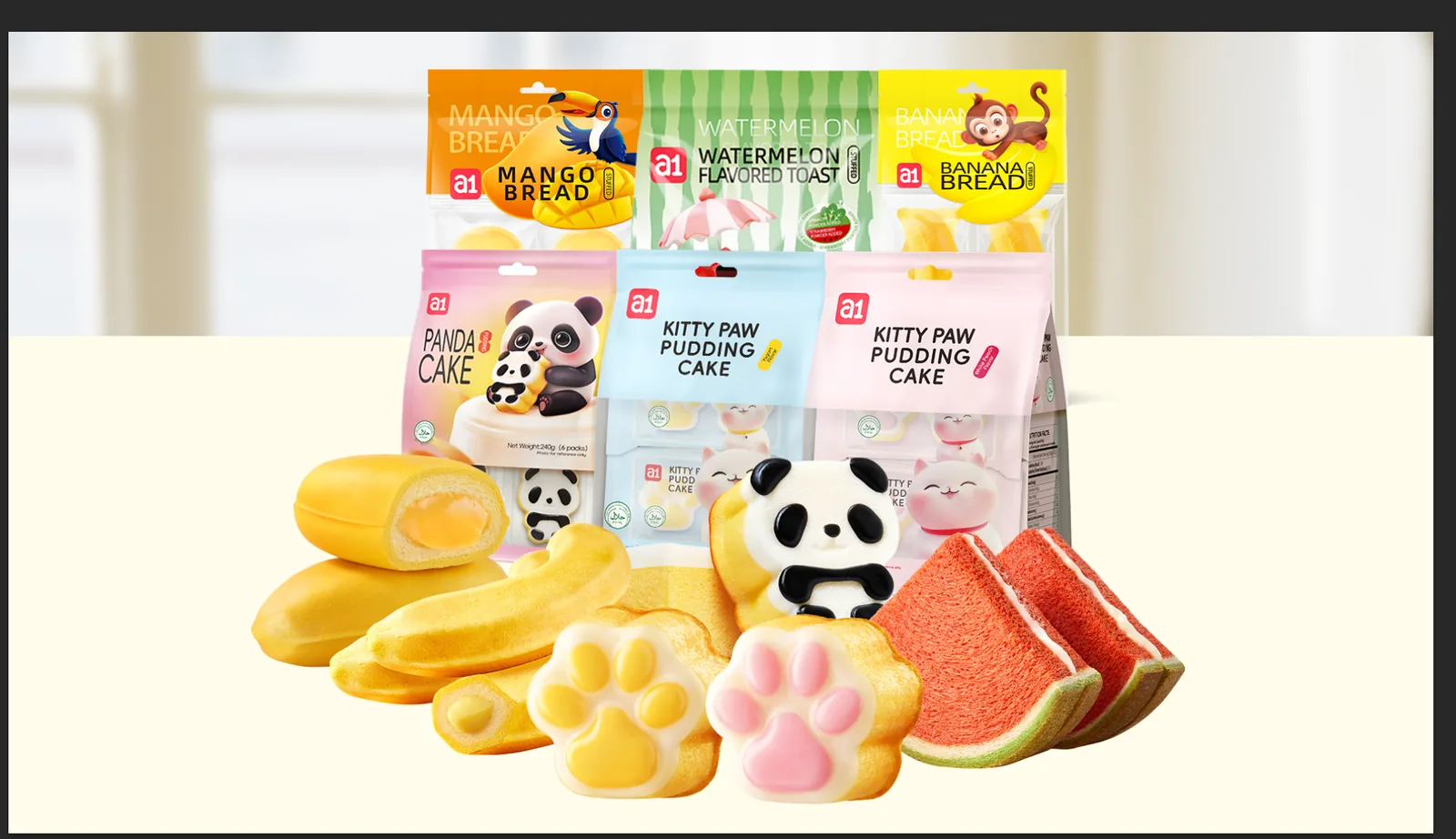
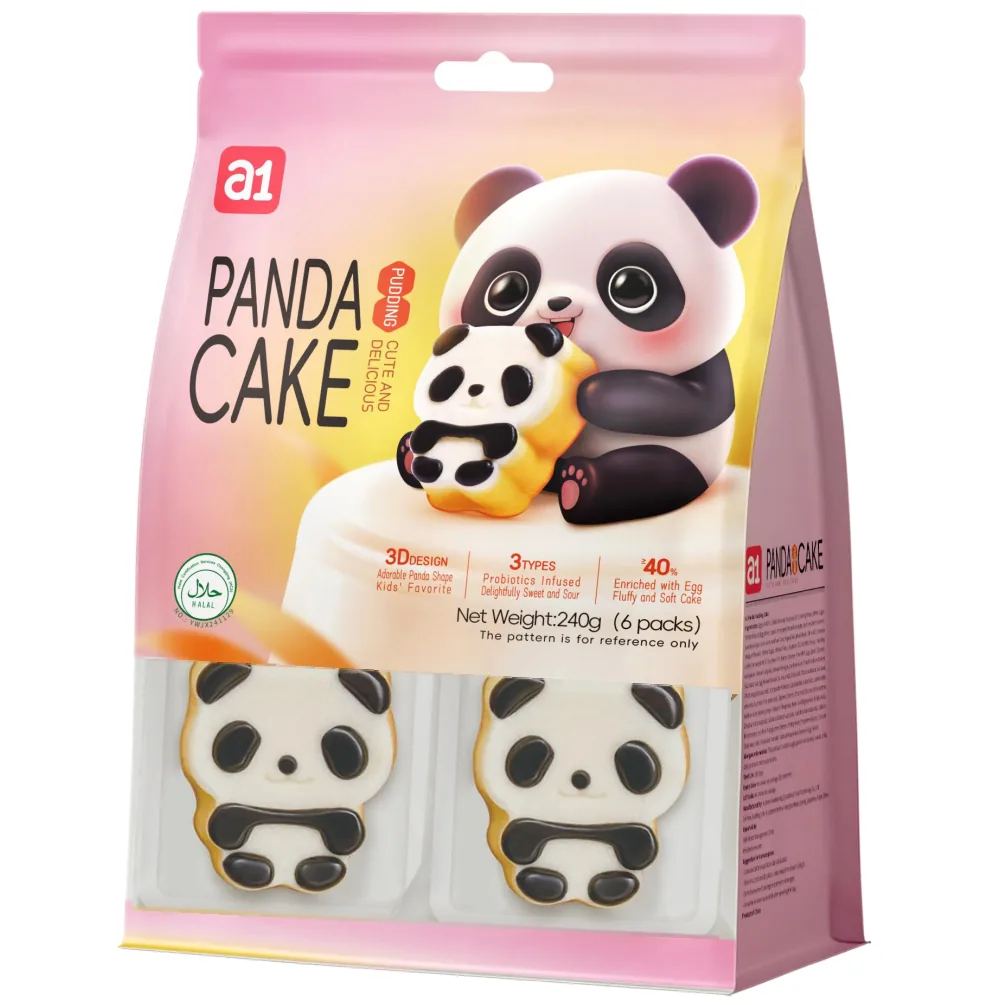
For bakery specifically, shelf life is a commercial weapon. Six months on filled toasts and pudding cakes, nine months on rice-cake cookies, means your product survives cross-border tender timelines, bonded storage and slow-moving regional distribution — the periods where short-life competitors fail. Container economics follow: one 40HQ container loads about 2,204 cartons of 188 g stuffed toast (12 bags per carton), about 2,066 cartons of 90 g rice-cake cookies (24 per carton), about 1,860 cartons of 248 g banana bread, or about 1,518 cartons of 240 g panda pudding cakes (12 per carton). Those numbers decide whether your landed cost per shelf-slot works — the 188 g stuffed watermelon toast and the Panda Pudding Cake product pages carry the full carton and loading specifications.
6. First-order checklist for bakery buyers
Putting it together, the sequence we recommend to first-time chain and distribution buyers:
- Define your destination market and scheme requirements — which GFSI scheme your chain accepts, which halal scheme your market’s authority recognizes.
- Request the certificate pack — GFSI, halal, BSCI plus recent COAs, so your QA department verifies instead of trusts.
- Evaluate samples against specification — texture, filling ratio, packaging integrity after simulated transit.
- Confirm commercial terms — our MOQ policy is MOQ from 500 cartons per SKU, 200-carton trial orders for new markets.
- Agree the loading plan — 20GP or 40HQ, mixed SKU loading where the market needs a range.
- Run the trial order, review, then scale — use the trial window to validate the channel before committing shelf space.
Two of our earlier guides answer the questions bakery buyers usually ask next: how to import stuffed toast from China, with the MOQ and 40HQ checklist, and why a character SKU like the Panda Pudding Cake opens doors no generic cake can. If you are building a bakery program and want a supplier whose paperwork survives your QA department, send your specification through the contact form or write to Katherine at Justin@a1food.cn or WhatsApp +86-189-6548-2111.